


Environmental Impact of Free-Roaming Cats in the United States: 10 Facts Every Cat Lover Should Know

Free-roaming cats in the United States kill an estimated 1.3 to 4 billion birds and 6.3 to 22.3 billion mammals every year, which makes them one of the most significant human-associated threats to native wildlife.
As a company dedicated to safe, humane cat containment, we want to help you understand this impact and show practical, kind ways to protect both your cat and local ecosystems.
We care deeply about cat safety, but we also recognize our responsibility to native wildlife and the broader environment. Understanding the science behind these numbers is the first step toward solutions that are compassionate to cats and realistic for U.S. communities.


These numbers can feel overwhelming, especially if you love both cats and birds.
We see them as a call to action for humane, practical containment rather than a reason to blame individual pet owners.


By preventing cats from roaming into adjacent forests and reserves, U.S. homeowners in these landscapes can play a direct role in protecting rare or localized species. Cat-proof fencing is especially valuable in these settings, because it acts as a clear physical boundary between your safe yard and sensitive habitats next door.
From an environmental standpoint, the most effective way to reduce this pressure is to keep cats contained and avoid feeding unowned cat colonies outdoors. From a cat‑care standpoint, containment also means fewer fights, fewer injuries, and less exposure to parasites and disease.

For rescue cats with trauma histories, safe containment is especially important, because roaming can expose them to triggers and dangers they are not ready to handle. Our own guidance for rescue guardians focuses on creating secure yards that feel calm and predictable, which benefits both the cat and local wildlife.


When you contain your cat, you also reduce complaints from neighbors about hunting in their yards, which can help keep peace in the community. You protect birds at the feeder, small mammals in the garden, and reptiles sunning on rocks, all while keeping your feline companion close and secure.

For many U.S. families, cost is easiest to manage by choosing a kit that matches the linear footage of their yard perimeter. We offer combinations that suit small city gardens through to expansive suburban lots, so you can choose a configuration that fits both your layout and your budget.
The result is a yard where your cat can relax and explore without slipping out to hunt. For local birds, mammals, and reptiles, that simple boundary can mean thousands of avoided predation events over the lifetime of a single cat.
For wildlife, this means fewer nesting failures, more surviving juveniles, and healthier small mammal and reptile populations. For cat owners, it means peace of mind, less worry about road traffic, and fewer surprise vet bills from roaming injuries.
Key Takeaways
| Question | Short Answer |
|---|---|
| How do free-roaming cats affect U.S. wildlife? | They are estimated to kill billions of birds and mammals annually, putting pressure on already stressed native species. |
| Are feral cats the main problem? | Yes, research shows that unowned cats cause most wildlife deaths, but owned outdoor cats still contribute significantly. |
| Why is keeping cats contained better for the environment? | Cat containment sharply reduces predation and roaming, so your cat does not add to the toll on local birds, small mammals, reptiles, and insects. |
| Can humane cat-proof fencing really help? | Yes, keeping your cat safely in your yard with systems like our 40' Cat-Proof Fence Kit prevents hunting trips while still offering outdoor time. |
| Is this only a rural issue? | No, both suburban and urban free-roaming cats impact backyard songbirds, small mammals, and even urban reptiles and insects. |
| What is the most cat-friendly way to help wildlife? | Provide safe outdoor access in a contained yard instead of unrestricted roaming, and support community efforts that manage feral cat populations humanely. |
| Where can I learn about installation and planning? | Our step‑by‑step installation guide shows how to set up cat-proof fencing in a way that is safe for cats and local wildlife. |
1. Why Free-Roaming Cats Are an Environmental Issue in the United States
Free-roaming cats include owned outdoor cats, strays, and feral cats, and together they form a large, efficient predator population that is entirely supported by people. In the United States, studies estimate that these cats kill between 1.3 and 4.0 billion birds and 6.3 to 22.3 billion mammals each year, which is a scale of mortality that native ecosystems did not evolve with. Cats in U.S. neighborhoods hunt in backyards, parks, farms, and nature reserves, often in areas that already face habitat loss and fragmentation. When we allow cats to roam, we unintentionally export the risks of predation, disease, and competition far beyond our own property lines.We care deeply about cat safety, but we also recognize our responsibility to native wildlife and the broader environment. Understanding the science behind these numbers is the first step toward solutions that are compassionate to cats and realistic for U.S. communities.
2. What Free-Roaming Cats Hunt: Beyond Just Backyard Birds
Many people picture cats only catching the occasional bird or mouse, yet diet studies show a far broader impact on wildlife. Globally, researchers have identified 2,084 prey species in cat diets, and about 47 percent of these are birds, 22 percent reptiles, and 21 percent mammals, with insects and amphibians making up the rest. In the United States, this means that free-roaming cats do not only affect songbirds at the feeder. They also prey on small native mammals such as voles and shrews, juvenile rabbits, lizards and snakes, and beneficial insects that help control pests and pollinate plants.Key point: Approximately 9 percent of all known bird species, 6 percent of mammals, and 4 percent of reptiles worldwide have been documented in cat diets, which shows how broad their ecological reach is.When this hunting is multiplied by tens of millions of cats across the country, the cumulative impact on local food webs becomes very real. Even if your individual cat seems to bring home only a few animals, studies suggest that total kills are often much higher than the number of carcasses you see.
3. The Numbers in the U.S.: Birds, Mammals, and More
Across the United States, researchers estimate that free-ranging cats kill a median of about 2.4 billion birds per year, which makes cat predation one of the largest human-associated sources of bird mortality. Mammals face an even greater toll, with a median estimate of around 12.3 billion individuals killed annually, often species that are important for soil health and seed dispersal. Unowned cats, which include strays and feral animals, cause most of these deaths, yet owned outdoor cats still account for hundreds of millions of kills each year. Cornell Lab of Ornithology notes that about 69 percent of bird deaths from cats are caused by unowned cats, but that leaves roughly one‑third coming from pets.| Group | Estimated Annual U.S. Deaths from Cats | Main Drivers |
|---|---|---|
| Birds | 1.3–4.0 billion | Mostly unowned cats, with significant contribution from outdoor pets |
| Mammals | 6.3–22.3 billion | Unowned cats hunting small native and introduced mammals |
| Other wildlife | Not fully quantified | Reptiles, amphibians, and insects taken as incidental prey |
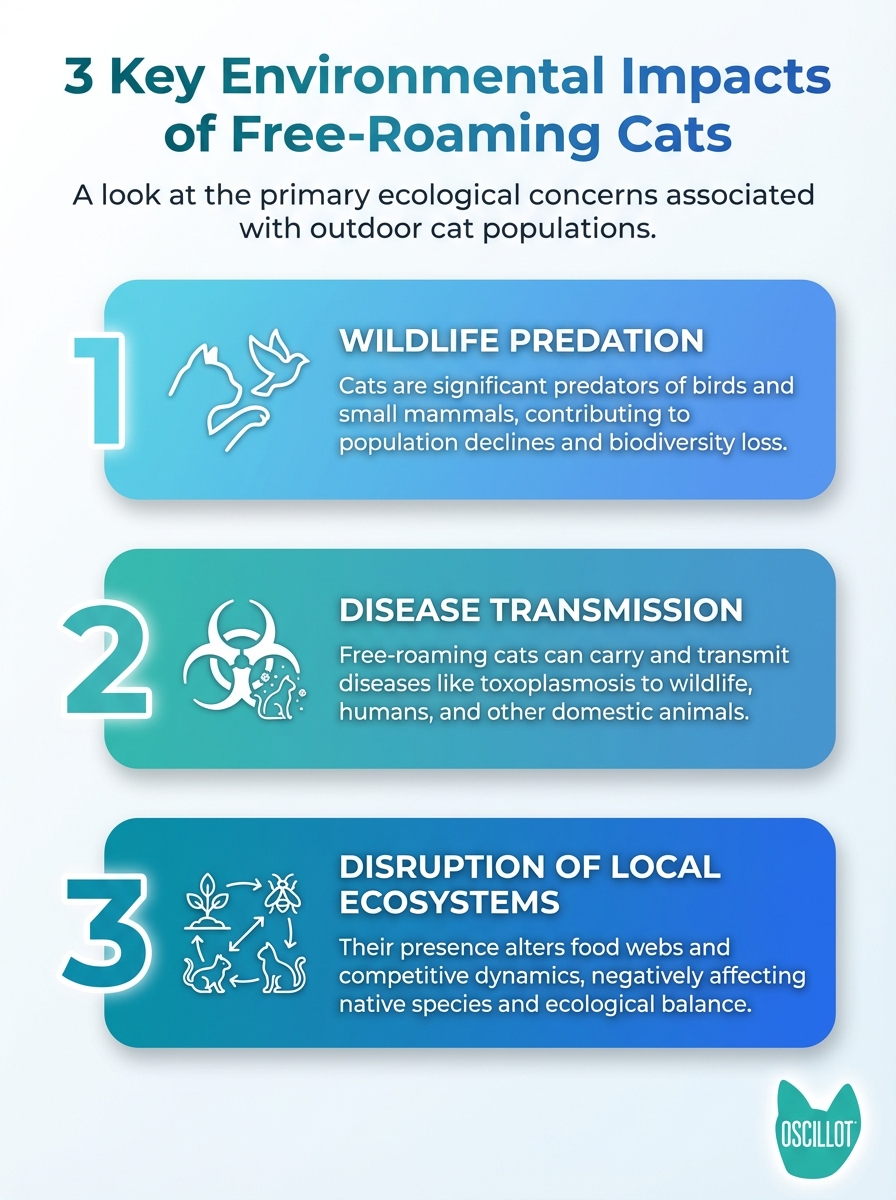
This infographic highlights three major environmental impacts of free-roaming cats. It helps readers quickly grasp their ecological footprint.
Did You Know?
In the United States, free-ranging cats kill an estimated 1.3–4.0 billion birds and 6.3–22.3 billion mammals every year.
4. Island and Mountain Ecosystems: Where Cats Hit Hardest
Some U.S. ecosystems are especially sensitive to cat predation, including islands and isolated mountain communities. Globally, cats have been linked to 26 percent of documented bird, mammal, and reptile extinctions, and islands tend to hold a higher share of threatened species in cat diets. In mountain and foothill regions of the western United States, free-roaming cats can encounter ground-nesting birds, small endemic mammals, and reptiles that already face habitat pressures. Our own work with cat containment in mountain homes has shown that people in these areas are often very motivated to protect both their cats and vulnerable wildlife.
By preventing cats from roaming into adjacent forests and reserves, U.S. homeowners in these landscapes can play a direct role in protecting rare or localized species. Cat-proof fencing is especially valuable in these settings, because it acts as a clear physical boundary between your safe yard and sensitive habitats next door.
5. How Free-Roaming Cats Disrupt Local Food Webs
Cats do not simply remove individual animals from the environment, they disrupt predator‑prey relationships at multiple levels. When cats heavily reduce small mammal populations, it can change seed dispersal patterns, soil turnover, and food availability for native predators such as hawks, foxes, and owls. This kind of disruption is especially pronounced in suburban and urban edges where native predators are already reduced. In those areas, cats can become the dominant small‑animal predator, which shifts the balance of local food webs away from natural processes.From an environmental standpoint, the most effective way to reduce this pressure is to keep cats contained and avoid feeding unowned cat colonies outdoors. From a cat‑care standpoint, containment also means fewer fights, fewer injuries, and less exposure to parasites and disease.
6. Owned Outdoor Cats vs. Feral Cats: Who Causes More Harm?
Research is clear that unowned cats, especially dense feral colonies, cause the majority of wildlife kills in the United States. However, because there are so many pet cats that are allowed to roam, the combined impact from owned outdoor cats remains very large. The environmental difference between a cat that is indoors or safely contained and a cat that roams freely is dramatic. This is why we focus on empowering individual owners with practical tools, rather than relying solely on broad policy changes that are slow to implement.For rescue cats with trauma histories, safe containment is especially important, because roaming can expose them to triggers and dangers they are not ready to handle. Our own guidance for rescue guardians focuses on creating secure yards that feel calm and predictable, which benefits both the cat and local wildlife.
7. Why Containing Cats Is Safer for Wildlife and for Your Cat
Statistics show that cats kept safe at home outlive free‑roaming cats by 8 or more years on average, because they avoid traffic, predators, toxins, and fights. From an environmental perspective, contained cats also avoid contributing to the massive annual toll on birds, mammals, reptiles, and insects. Humane cat containment lets you offer your pet fresh air, sunshine, and enrichment while still respecting the needs of native species. We design our systems so there are no cages, no nets, and no electric currents that could harm your cat, just a smooth spinning barrier that stops climbing.
When you contain your cat, you also reduce complaints from neighbors about hunting in their yards, which can help keep peace in the community. You protect birds at the feeder, small mammals in the garden, and reptiles sunning on rocks, all while keeping your feline companion close and secure.
Did You Know?
Globally, cats have been linked to 26% of documented bird, mammal, and reptile extinctions, which shows why reducing free-roaming is so important for biodiversity.
8. Cat-Proof Fence Systems as a Humane Conservation Tool
From our perspective, cat-proof fence systems are one of the most practical tools U.S. households can use to cut predation without limiting quality of life for cats. Our modular kits are designed for durability, so they keep spinning through dust, rain, and snow, and they work with a wide range of existing fence types. Because the system sits on top of your existing fence, it creates a clean, unobtrusive barrier that does not turn your yard into a cage. All you need are a few basic tools and a few hours of time, or you can bring in a local handyman if you prefer not to DIY.For many U.S. families, cost is easiest to manage by choosing a kit that matches the linear footage of their yard perimeter. We offer combinations that suit small city gardens through to expansive suburban lots, so you can choose a configuration that fits both your layout and your budget.
9. Planning and Installing a Cat-Proof Fence with the Environment in Mind
Good planning prevents small gaps and launch points that would let a determined cat escape and continue to hunt wildlife. We encourage owners to walk their fence line, move objects away from the top of the fence, and check gates, trees, and sheds before installing any system. Our installation guidance explains how to create an unbroken barrier along fences that are at least six feet high, and how to address common mistakes. Where trees or structures sit close to the fence, additional tools such as tree guards can help stop climbing routes without harming the tree.The result is a yard where your cat can relax and explore without slipping out to hunt. For local birds, mammals, and reptiles, that simple boundary can mean thousands of avoided predation events over the lifetime of a single cat.
10. Large Properties and Community-Scale Impact
In the United States, many properties, especially in rural and semi‑rural areas, have long fence lines that can seem hard to secure. For those homes, extended cat-proof fence kits allow you to contain multiple cats across hundreds of feet of boundary, which significantly reduces roaming. When a neighborhood or community decides to prioritize containment together, the effect on local wildlife can be substantial. Each property that commits to keeping cats on their own land removes a set of roaming predators from parks, reserves, and neighboring yards.For wildlife, this means fewer nesting failures, more surviving juveniles, and healthier small mammal and reptile populations. For cat owners, it means peace of mind, less worry about road traffic, and fewer surprise vet bills from roaming injuries.


