


How Cat-Proof Fence Rollers Really Work: The Complete Oscillot Guide For U.S. Homes

Oscillot reports a 99.9% effectiveness rate across more than 50,000 installations worldwide, which is why so many cat parents in the United States now rely on cat-proof fence rollers to keep their cats safely at home. In this guide, we explain exactly how these spinning paddles work, what makes them different from taller fences or netting, and how to choose the right setup for your property.
Key Takeaways
| Question | Short Answer |
|---|---|
| How do cat-proof fence rollers stop cats? | They sit along the top of a 6 ft or higher fence and spin when a cat tries to grab them, removing the firm grip needed to climb or balance. |
| What system are we talking about in this article? | We focus on Oscillot cat-proof fence rollers and our Cat-Proof Fence Kits, which are designed for U.S. backyards. |
| Do I need a minimum fence height? | Yes, Oscillot recommends a minimum fence height of about 6 feet for effective containment with the roller system. |
| How do I know how many paddles and posts I need? | Use our online Cat Fence Calculator after you measure your yard to estimate the kit size for your fence run. |
| Can the system fit different fence types in the U.S.? | Yes, our guidance on Cat Proofing Your Fence Type explains bracket choices for wood, vinyl, metal, and composite fences commonly used across the United States. |
| Is there support if I have installation questions? | We provide a detailed Installation Guide along with direct support through our Contact Us page. |
| What if the system does not work for my cat? | You can take comfort in our 60-Day Money Back Guarantee and our Product Warranty for long-term confidence. |
1. What Cat-Proof Fence Rollers Are And Why U.S. Cat Owners Use Them
Cat-proof fence rollers are spinning paddles that mount along the top of an existing fence, creating a moving barrier that cats cannot gain a solid grip on. Instead of trying to cage your cat in, the system relies on physics and feline behavior to keep your cat safely inside your U.S. yard.
Most American neighborhoods have 6 ft privacy fences or similar boundaries, which are not enough on their own for determined climbers or jumpers. Our system adds only a small amount of visible hardware to the top line of your fence, so you keep your views and your yard’s appearance while giving your cat secure outdoor time.


We designed Oscillot for cat owners who want an open, non-cage solution that respects both their cat’s natural curiosity and their neighbors’ peace of mind. No cages, no nets, and no loose wires are involved, just a robust, low-profile, mechanical barrier that responds instantly when a cat tries to climb.
Because cats in the United States face risks from cars, coyotes, dogs, local trapping, and wildlife, keeping them inside the yard is about safety as much as convenience. Fence rollers answer that need while still allowing your cat to enjoy fresh air and sunshine.
2. The Basic Mechanics: How Spinning Paddles Stop Climbs And Jumps
Cats climb by launching, gripping, and then pulling their weight upward using their front paws and claws. Our rotating paddles interrupt that process at the top of the fence where the grip matters most, so the cat cannot pull over the edge into a neighbor’s yard or street.
When a cat reaches up to hook its paws over the fence line, the paddles roll freely under the cat’s weight. That unexpected movement shifts the body backward, forces the paws to slip, and makes the top edge feel unsafe, so most cats naturally drop back into their own yard and learn not to try again.


Oscillot paddles are made from durable aluminum and sit in specially designed posts so they spin freely without lubrication in normal conditions. This simple, passive design means there are no motors, wires, or electronics to maintain in typical U.S. weather, from hot summers in Arizona to wet winters in the Pacific Northwest.
Because the paddles run in a continuous line where possible, there are no convenient gaps where a cat can gain a stable handhold. That continuous spinning barrier is what gives fence rollers their high real-world success rate.
3. Why Height Alone Is Not Enough For Athletic American Cats
Many U.S. cat owners first try adding height to their fence or putting lattice on top, then watch their cat simply climb or jump higher. Cats can reach jumps of 6 to 8 feet vertically, and an average observed jump height around 7 feet makes most backyard fences alone unreliable for determined pets.
Jumpers, the particularly athletic cats that clear fences with ease, make up about 25% of escaped cats. Even if your current cat is not a high jumper, adopting a younger or more athletic cat in the future can quickly expose the limits of a height-only solution.
Our approach focuses on the critical point where the cat needs to gain balance on the top of the fence. By making that top edge unreliable and constantly moving, we prevent both climbers and jumpers from completing their escape, even if they can reach the top with a powerful launch.
This is why we recommend a minimum fence height of about 6 feet for U.S. yards. Combined with a spinning barrier, that height makes clear, successful jumps very unlikely while still meeting many local regulations and HOA guidelines.
A simple three-step visual guide to how Oscillot cat-proof fence rollers work. This infographic helps homeowners understand how the rollers deter climbing and keep cats safe.
4. Inside An Oscillot Roller: Paddles, Posts, And Hardware Explained
Oscillot uses horizontal aluminum paddles that connect end to end and sit between specially designed posts along the fence top. Each post keeps the paddles aligned and allows smooth rotation when a cat adds weight from any direction.
The paddles are engineered for durability, weather resistance, and long-term performance in American climates. They are powder-coated for appearance and protection, so they continue to look neat on your fence while quietly doing their job every day.
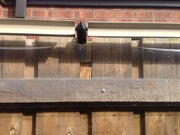
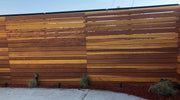
We supply brackets and fixings that work with standard U.S. fence materials like wood privacy panels, vinyl fences, and metal fences. Our guidance on cat-proofing your fence type walks you through bracket placement so the paddles sit in the right position relative to the top rail.
If your yard has multiple corners, gates, or changes in elevation, extra posts can be added to maintain alignment. This flexibility allows our system to adapt to real-world American yards instead of requiring a perfectly straight commercial-style boundary.
5. Choosing The Right Oscillot Cat-Proof Fence Kit Length
To make planning easier, we offer our cat-proof fence rollers in preconfigured DIY kits sized for the total length of fence you want to protect. You choose the kit length that matches your measurement, then we provide the paddles and posts to cover that run.
For example, our 4' Cat-Proof Fence Kit (DIY) is an entry-level kit designed for very short runs or testing a section of fence. It is ideal for small side yards or short connecting stretches between structures.
Our 8' Cat-Proof Fence Kit (DIY) is suitable for standard fence segments or where you need to secure one side of a patio or gate area. For many U.S. townhomes and smaller suburban properties, a combination of 4 foot and 8 foot kits gives precise coverage without significant waste.
As your fence length increases, you can choose longer kits like 60 foot, 80 foot, 120 foot, or even 300 foot to match typical American lot sizes. We designed these options so homeowners can cover everything from compact city yards to large rural boundaries with the same proven roller design.
6. Real-World Examples: Comparing 60', 80', 120', And 300' Kits
For mid-sized U.S. yards, our 60' Cat-Proof Fence Kit (DIY) is a popular choice, priced at $1,418.60 at the time of writing. It includes paddles and posts to cover approximately sixty linear feet of fence, which often matches a typical back or side yard run.
The 60 foot kit is ideal for many detached homes where you want to secure the primary area your cat uses, without necessarily enclosing the entire property boundary line. It is a balance between coverage and cost for U.S. families who want to start with the highest risk section.
The 80' Cat-Proof Fence Kit (DIY) and 120' Cat-Proof Fence Kit (DIY) serve larger backyards or combined side and back runs, giving more flexibility for rectangular suburban lots. These are common choices when you want your cat to roam the entire backyard safely.
For very large properties, the 300' Cat-Proof Fence Kit (DIY) provides extended coverage. With a price of $2,128.40, it is designed for long perimeter lines, rural fencing, or U.S. properties where cats share outdoor spaces with dogs and need consistent containment across a broad boundary.
All of these kits rely on the same technology, high quality aluminum paddles, and robust posts. The difference lies in the total linear coverage, which is why accurate measuring and planning are so important before you place an order.
If you are unsure what length fits your United States property, we always recommend measuring the full run you intend to secure, then using our calculator or contacting us for tailored guidance.
7. Measuring Your U.S. Yard And Using The Cat Fence Calculator
The effectiveness of cat-proof fence rollers depends on covering the correct fence runs without leaving exploitable gaps. That is why we created clear guidance on how to measure your yard and match those measurements to kit sizes.
Our How to Measure Your Yard page walks you through each step. You measure each fence section that your cat could use to leave your property, including straight runs, corners, and transitions around gates or sheds.

Once you have those measurements, you can enter them into our online Cat Fence Calculator. The calculator estimates how many paddles and posts you need and suggests kit combinations that fit your total length with minimal excess.
This step helps U.S. homeowners avoid under-ordering or significantly over-ordering components. It also provides a clear cost expectation before you commit to a specific configuration for your cat’s safety.
8. Adapting Rollers To Different U.S. Fence Types And Yard Features
American yards use many fence styles, from 6 ft wooden privacy fences to vinyl, chain link with privacy slats, and metal panel systems. Our system is designed to adapt to these fence types through different bracket choices and mounting positions.
The Cat Proofing Your Fence Type guide shows how to place the posts and paddles so that the rollers sit either directly above the fence line or slightly inside the property, depending on your fence design. Correct placement ensures that when your cat reaches for the top, it contacts the paddle and not a stable rail.

We also provide a detailed Common Mistakes guide that shows typical alignment and gap issues to avoid. For example, leaving a wide gap between the paddle and a shed roof can give a determined cat a bypass route even if the fence line itself is secure.
For trees, utility structures, or other climbable features inside a U.S. yard, our Cat Tree Guard product extends the same spinning principle. It wraps around trunks or posts so your cat cannot use them as a ladder to reach neighboring yards or streets.

This combination of fence-top rollers and targeted tree protection is especially useful in U.S. neighborhoods with mature landscaping or utility easements behind back fences. It lets cats enjoy shade and climbing opportunities inside the yard while preventing escapes over natural ladders.
For long, varied runs, our spare parts collection provides extra posts and components so you can keep the roller line continuous over every potential escape route on your property.
9. Installation, Common Mistakes, And Typical Time For U.S. DIY Projects
Oscillot was designed for easy do-it-yourself installation, which suits many U.S. homeowners who are comfortable with basic tools. Average installation time for a typical front-yard or backyard setup is about 3 to 6 hours, depending on fence length and complexity.
Our step-by-step Installation Guide explains how to position posts, join paddles, and secure brackets without specialized equipment. We recommend laying out components on the ground first, then mounting from one end to the other to keep the line straight.
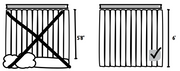
The most common installation mistakes involve gaps or misalignment. Examples include leaving an open section near a gate, placing the paddles too far from a nearby shed roof, or misjudging a corner so the roller sits where the cat cannot reach it.
We encourage U.S. customers to read the common mistakes page before starting, then walk the full fence line afterward from a cat’s perspective. If you spot any place where your cat might reach a stable surface above the rollers, small adjustments or additional posts usually resolve it quickly.
10. Safety, Aesthetics, Warranty, And Support For U.S. Customers
We know American pet parents care deeply about safety, humane design, and how their yard looks. Oscillot is the original, 100% Australian-made cat-proof fence roller system, and our product line emphasizes no cages, no nets, and no loose wires that could harm your cat or wildlife.
The system adds only a compact profile along the top of your existing fence, which many U.S. HOAs and neighbors appreciate compared to bulky enclosures. It also helps protect native wildlife near your property by reducing your cat’s access to birds and small mammals beyond your fence.
To give U.S. homeowners extra peace of mind, we offer a 60-Day Money Back Guarantee on Oscillot cat-proof fence kits purchased directly from our site. If the system does not work for your situation after proper installation and adjustments, you can return it within that window under the posted terms.
We also provide a detailed Product Warranty that covers manufacturing defects, reflecting our confidence in high quality components that are made to last for years in U.S. conditions. If you ever need help, our Contact Us page connects you to support for product questions, installation advice, and order assistance.
Conclusion
Cat-proof fence rollers work by taking away the one thing every climbing or jumping cat needs, a stable grip at the top of your fence. By adding freely spinning, durable paddles along your existing 6 ft or higher boundary, you create a humane, low-visibility barrier that keeps your cat safely inside your U.S. yard without cages or nets.
From compact 4 foot kits to 300 foot perimeter systems, Oscillot gives American homeowners a proven way to protect curious cats, respect neighbors, and support local wildlife. With careful measuring, correct fence-type adaptation, and attention to small gaps, you can join tens of thousands of owners who now enjoy secure outdoor time with their cats and the peace of mind that comes with it.


