


Ultimate Guide to DIY Cat Containment Fundamentals: 10 Steps Every U.S. Cat Owner Should Know

Indoor-only and safely contained cats in the United States often live 15 to 17 years, while unsupervised outdoor cats average just 2 to 5 years, which is a powerful reason to keep your cat protected on your property with a DIY-friendly system. In this guide we walk you through the fundamentals of do-it-yourself cat containment so you can give your cat safe outdoor time without risking traffic, predators, or wildlife harm.
Key Takeaways
| Question | Answer |
|---|---|
| What is the safest DIY way to contain my cat in my U.S. yard? | The safest DIY method is a purpose-made cat-proof fence system that mounts to your existing fence, such as the paddle-style kits in our cat-proof fence kit collection, which are designed to stop climbing without cages or nets. |
| Can I install a cat containment system myself? | Yes, our kits are built for homeowners to install with standard tools, starting with compact options like the 4' Cat-Proof Fence Kit (DIY) for smaller areas. |
| How do I size a cat-proof fence kit for my property? | Measure the total length of fence where your cat could climb out, then choose a matching linear-foot kit such as the 60' Cat-Proof Fence Kit (DIY) for larger suburban yards. |
| Do I need extras around trees or sheds? | In many U.S. backyards, trees, sheds, and low roofs create “launch points,” and you can reinforce these areas using ideas from our additional cat proofing guidance. |
| Where can I learn the basics of how this system works? | You can review the concept and components in our overview page, What is Oscillot, then use this article to plan your DIY installation step by step. |
| Are there options for very large U.S. properties? | Yes, we offer extended kits such as the 120' Cat-Proof Fence Kit (DIY) and even larger configurations so you can cover long fence lines efficiently. |
| What if I want even more detail on systems? | For a deeper dive into system choices, you can also read our article Securing America’s Feline Friends, which discusses cat containment systems across the U.S. |
1. Why DIY Cat Containment Matters So Much In The United States
Cat ownership in the U.S. is widespread, with about 32.1% of households living with at least one cat, so safe outdoor access is a daily concern for millions of families. At the same time, cars, dogs, coyotes, and disease risks can turn an open yard into a hazard if a cat can roam beyond the fence.
Free roaming cats also affect local wildlife in American neighborhoods and rural areas. Global research has shown that free-ranging domestic cats consume 2,084 species, including hundreds of species of conservation concern, which means containment is not only about your pet, it is also about native birds, reptiles, and small mammals.
DIY cat containment lets you address both sides at once. You can keep your cat safely in your own yard while dramatically reducing hunting and injuries, all without resorting to cages or fully enclosed runs if you prefer an open-feeling yard.
Humane Containment Versus Restriction
We always focus on containment that feels normal to your cat, not punishment. Systems that sit on top of an existing fence keep your cat’s world familiar while quietly blocking the risky escape routes.
When you pair a physical containment system with enrichment like climbing posts, shaded spots, and toys, your cat can enjoy the outdoor sights and smells of a U.S. backyard without facing traffic or predators.

2. Core Principles Of A Safe DIY Cat Containment System
Every successful DIY cat containment setup in a U.S. yard rests on a few fundamentals. If you keep these in mind from the start, your project will be easier, safer, and more reliable.
First, any containment must be continuous. If there is even one gap, gate, or tree branch that functions as a bridge, your cat is likely to find it, especially over time.
Second, the top of the barrier is where most escapes happen. That is why we focus on top-of-fence systems that make the last few inches impossible to grip, so cats cannot get a stable hold to pull themselves over.
Third, durability is critical in a U.S. climate that includes intense sun, winter freezes, coastal salt air, and wind. A system that flexes or breaks after one season will not keep your cat safe “for life” the way we aim to do.
How Spinning Paddles Change Cat Behavior
Our paddle-based system works with feline instincts. When a cat jumps and grabs for the fence top, the paddle spins under their paws, so there is no solid edge to hook onto.
This is a physical, non-electric deterrent that does not rely on pain or fear, so it suits American families who want humane solutions that simply make escaping too awkward to attempt.
3. Assessing Your U.S. Property For Cat Escape Risks
Before you choose a kit, walk your entire fence line and yard with “cat eyes.” In American suburbs and rural properties, we routinely see similar escape patterns that you can check for in a few minutes.
Look especially at:
- Fence height below about 6 feet, which is easy for many cats to scale.
- Trees, sheds, air-conditioning units, or deck railings within jump distance of the fence top.
- Gates that have horizontal bracing your cat can use as a ladder.
- Gaps under fences where ground has eroded away.
It helps to observe your cat outside on a leash or supervised, because they often “map” the yard with their eyes and body language. If they keep looking toward a particular corner or tree, that is a likely future launch point that needs attention.
Common U.S. Yard Layouts And What They Mean
In dense urban areas, we often see solid wood or vinyl fences, which work very well with paddle systems because there are fewer gaps. In older U.S. neighborhoods and rural lots, mixed materials like chain-link, ranch rails, or stone walls may need some extra planning.
Regardless of layout, the goal is the same. You want a continuous, climb-resistant top edge all the way around the areas where your cat is allowed to roam.


A simple 4-step guide to DIY cat containment. Visualizes practical, humane steps to keep cats safe at home.
4. Choosing The Right Length DIY Cat-Proof Fence Kit
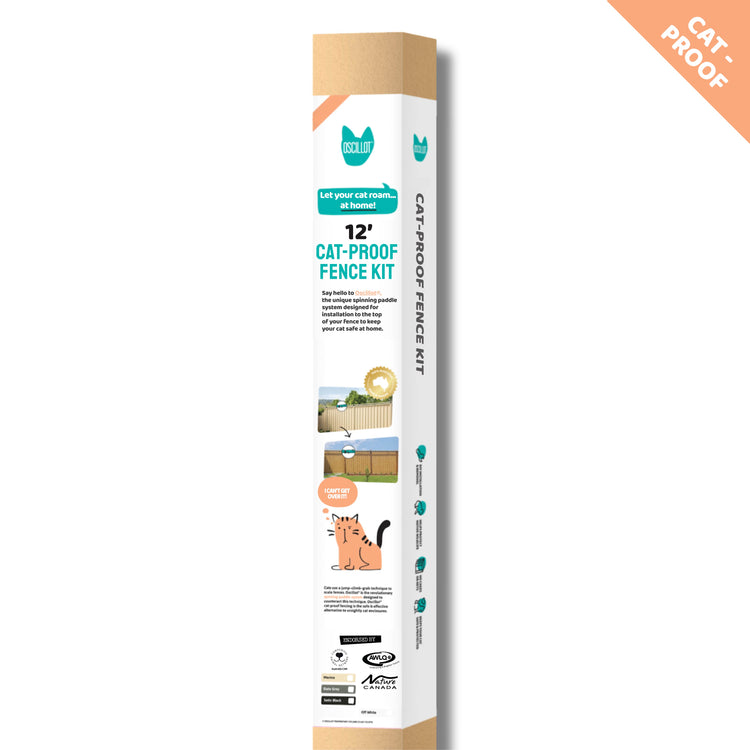
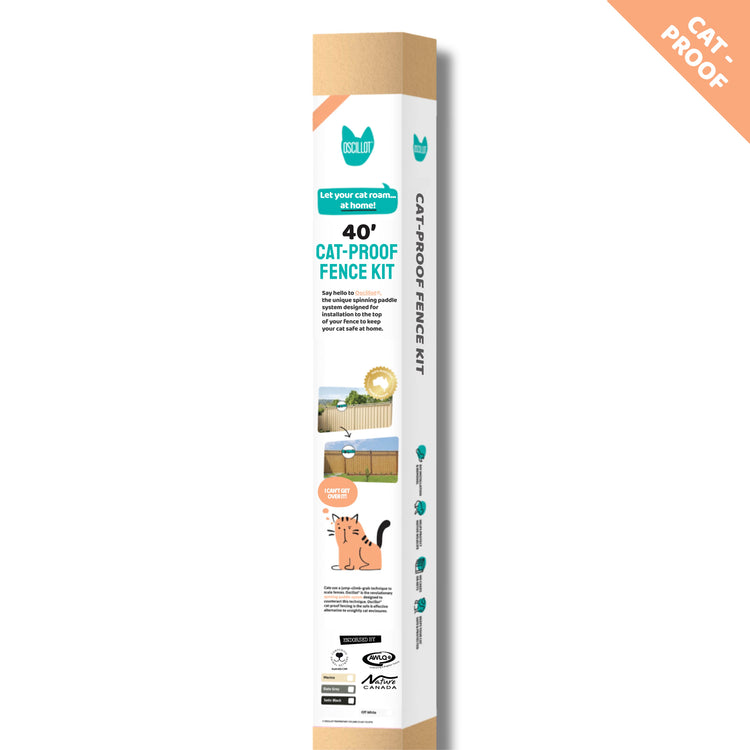
Once you know your fence length, you can match it to a kit size instead of buying components piece by piece. Our cat-proof fence kits range from 4 feet of coverage for very small sections to 120 feet and more for large American properties.
Below is a simple overview of how we see U.S. cat owners commonly match kit lengths to their yards.
| Kit Length | Typical U.S. Use Case |
|---|---|
| 4' Cat-Proof Fence Kit | Short sections, such as side returns or around a small patio gate. |
| 8' Cat-Proof Fence Kit | Townhome yards, or testing the system on a key “problem” section. |
| 12' to 20' Kits | Covering one side of a modest U.S. suburban yard. |
| 40' to 60' Kits | Most mid-sized backyards with full perimeter coverage. |
| 80' to 120' Kits | Large corner lots, mountain homes, and rural fences. |
Each kit includes paddles, posts, and hardware sized for the listed linear footage. If you are between sizes, we usually recommend rounding up so you have enough material to handle corners and small measurement errors.
Example Kits For Common American Yards
Many U.S. homeowners start with a compact kit like the 8' Cat-Proof Fence Kit (DIY) to protect a key escape section, then expand once they see how it performs. For full yard projects, it is common to choose a mid-range kit such as a 40 or 60 foot configuration.
Very large properties, such as U.S. mountain or acreage homes, often use multiple kits, for example one 120 foot kit plus an extra 20 foot kit to finish a long run. The goal is always the same, to keep your cat contained consistently around the entire allowed area.
5. Understanding Components: Paddles, Posts, And Hardware
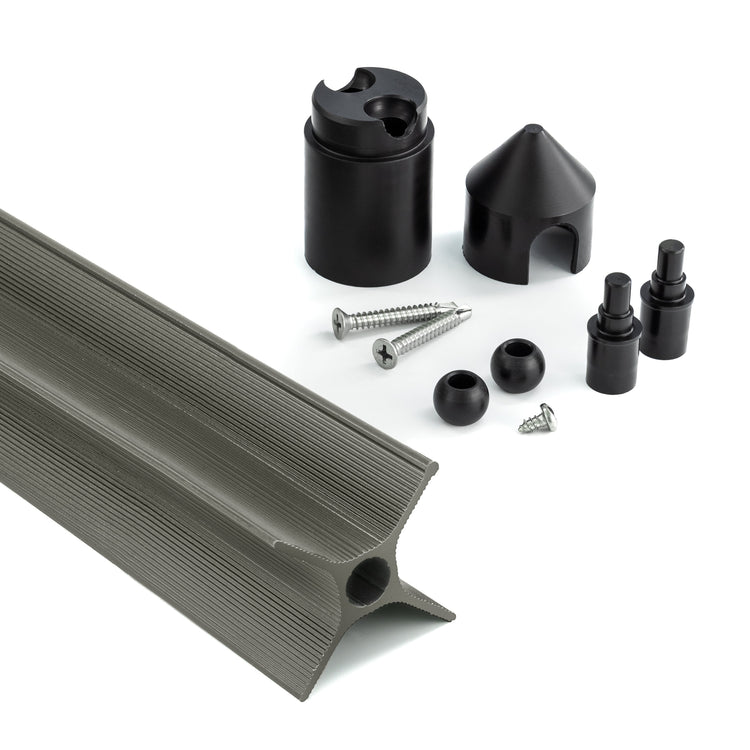
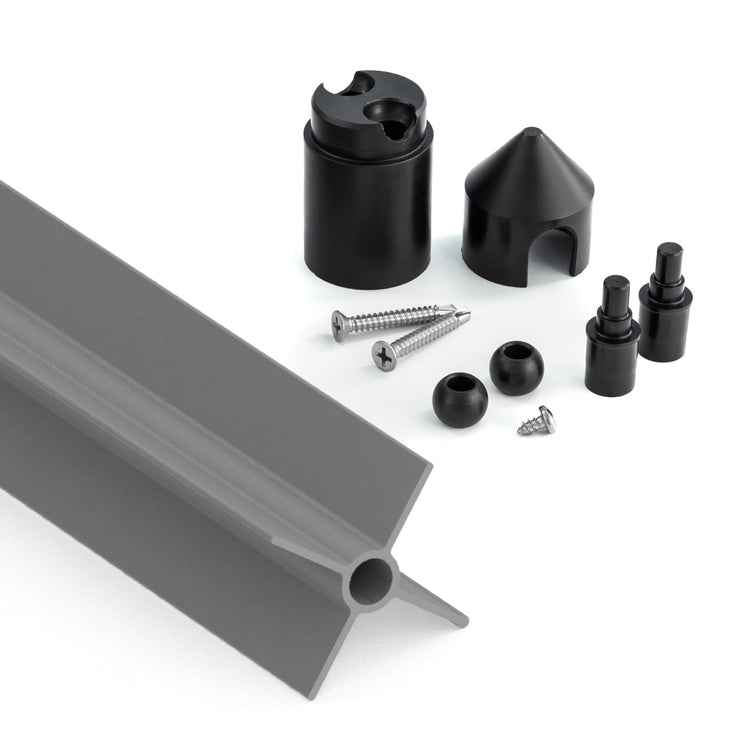
For a DIY installer, knowing what each part does makes the project feel manageable. Our cat-proof fence kits use just a few main components so you can quickly see how everything fits together.
- Paddles sit horizontally along the fence top and spin freely when a cat tries to grab them.
- Posts / brackets mount to the fence and support the paddles at the right distance from the top edge.
- End caps and joiners cover paddle ends, keep everything aligned, and protect the system from weather.
- Fasteners are chosen for common American fence materials like wood, metal, and masonry.
We use high quality materials to keep maintenance low in diverse U.S. climates. That includes UV-stable finishes to resist strong sun in places like Arizona and hardware that holds up in wet or coastal regions.
Color And Material Choices For U.S. Homes
In many American neighborhoods, homeowners want containment that blends with the fence, not a visually heavy cage. Our systems are slim and available in neutral tones that work well with typical vinyl, wood, or metal fences.
The goal is to keep your yard looking open and attractive while still giving your cat a reliable “invisible ceiling” they cannot get past.

6. Step‑By‑Step: Basic DIY Installation Fundamentals
While every yard is different, the core installation fundamentals stay the same. Most American homeowners with basic tools like a drill, tape measure, and ladder can handle the process.
- Measure and mark your fence line where paddles will run.
- Install brackets at the recommended spacing, checking they are level.
- Clip or slide paddles into place and connect them with joiners.
- Secure end caps and visually check for any gaps or low spots.
We recommend starting on the most straightforward stretch of fence so you can get comfortable with the components. Once you see the system in place, gates and corners feel much easier to tackle.
Planning For Corners And Gates
Corners in U.S. yards usually require slightly shorter paddle sections and careful bracket placement so the paddles clear one another. Gates may need brackets attached to the gate frame itself so that the barrier moves with the gate when you open it.
Before drilling, hold a few components loosely in place and swing the gate to be sure the paddles do not catch. This simple check prevents rework and keeps daily use smooth for your family.

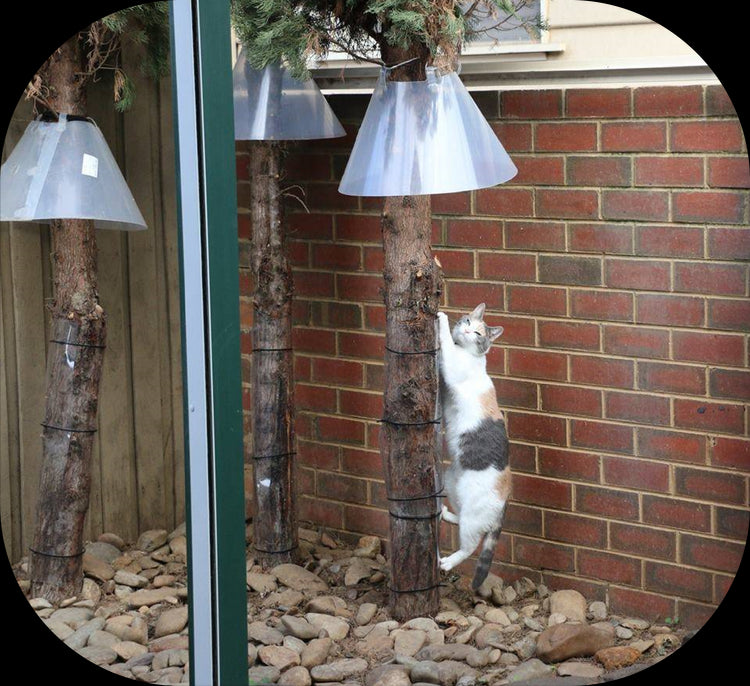
7. Additional Cat‑Proofing Around Trees, Roofs, And Obstacles
Containment fundamentals go beyond the fence top whenever your cat can bypass the fence entirely. In many U.S. yards, that means paying close attention to trees, rooflines, sheds, and outbuildings that sit near your boundary.
Our additional cat proofing ideas show how to handle scenarios where cats climb a tree, then step straight onto a fence or roof. Tree collars, trunk barriers, or short fence extensions can all block those shortcuts.
On low sheds or garages inside your yard, you may need to add short vertical extensions or angled panels to stop your cat jumping from the roof to the fence line. The goal is to keep every potential “bridge” from turning into an escape route.
Balancing Safety With A Natural Yard Feel
Most U.S. cat owners want to keep trees and landscaping because they provide shade and enrichment. We focus on targeted modifications, not removing everything your cat might climb.
By combining a top-of-fence system with a few strategic add-ons around problem areas, you can keep a mature American backyard intact while still ensuring your cat stays safely on your property.

8. Planning For Large U.S. Properties And Mountain Homes
In many parts of the United States, especially in the West and mountain regions, cats face additional risks from predators like coyotes along with steep terrain and long fence lines. Our experience with U.S. mountain homes shows that careful planning pays off here.
Long perimeters are often best handled with a combination of longer kits. For example, a large American property might use a 100 foot kit plus an extra 20 foot kit to finish a long hillside run where the fence zigzags in and out.
On sloped terrain, you want to keep the paddle line roughly level with the fence top even as the ground falls away. A mix of bracket heights and careful spacing ensures your cat cannot find a low spot to jump over.
Comparing Kit Options For Big Yards
Here is a simple comparison of some popular longer-length kits for U.S. properties.
| Kit | Best For |
|---|---|
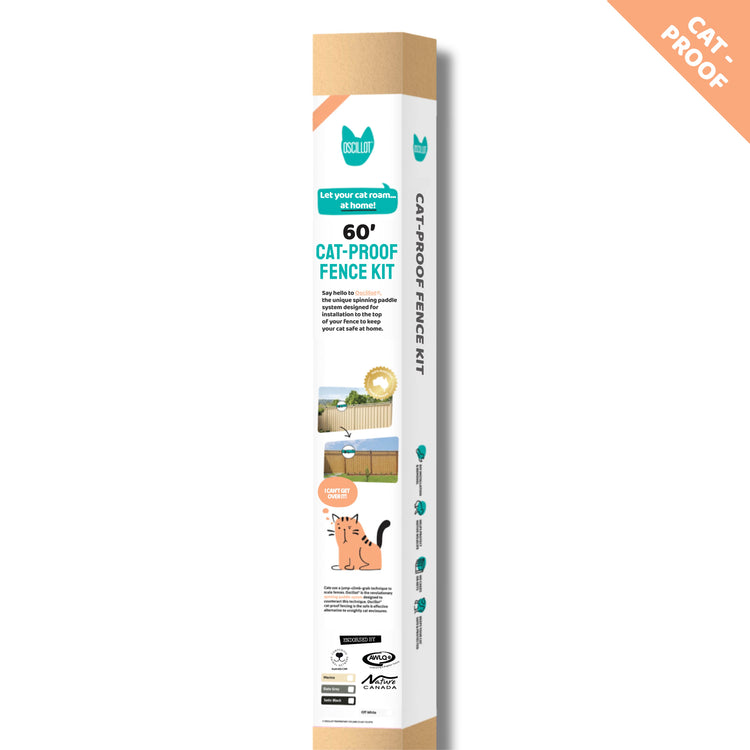
| 60' Cat-Proof Fence Kit | Standard American suburban backyards needing full perimeter coverage. |
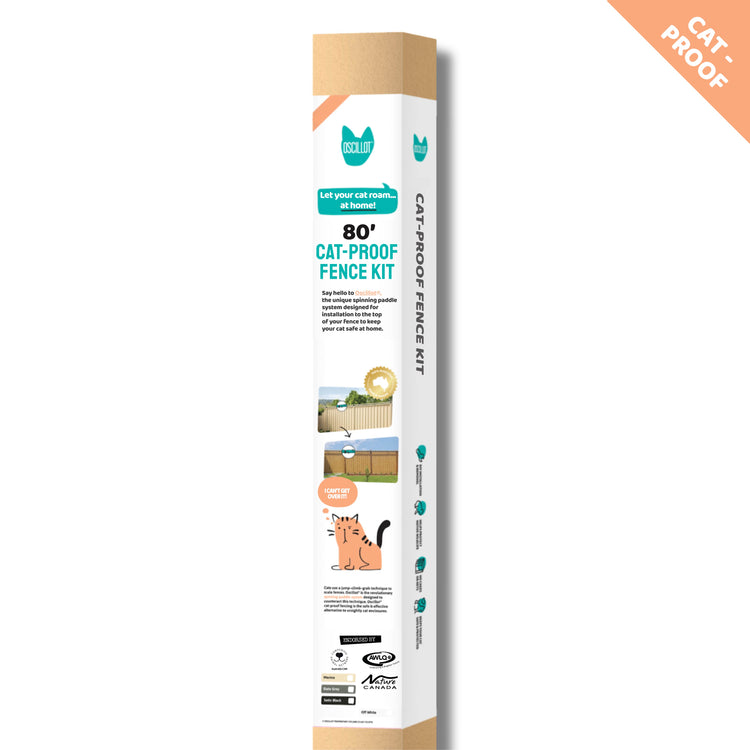
| 80' Cat-Proof Fence Kit | Larger corner lots or deep yards common in many U.S. suburbs. |
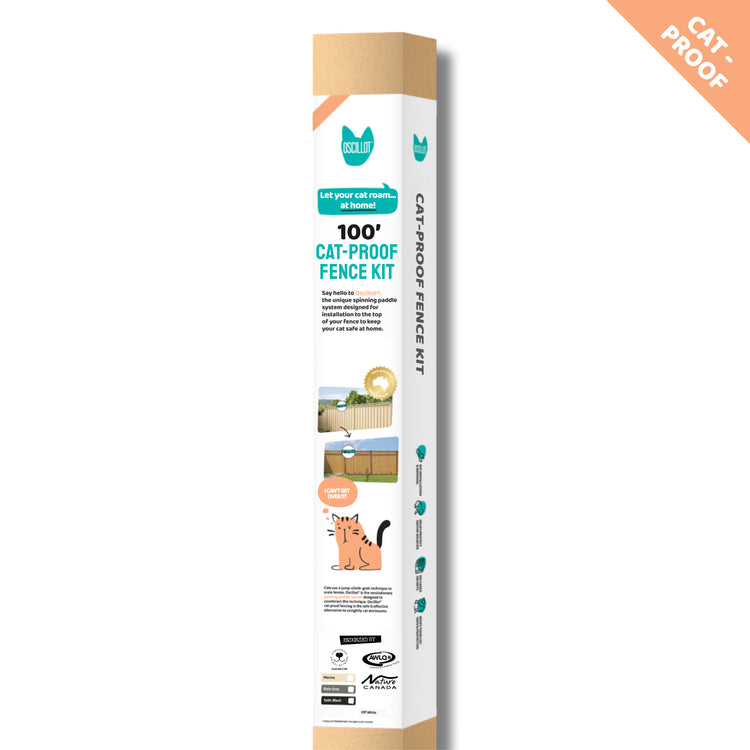
| 100' Cat-Proof Fence Kit | Long runs along one side of a property or shared boundaries. |
| 120' Cat-Proof Fence Kit | Extensive containment on acreage or mountain homes. |
9. Maintenance, Longevity, And Cost Fundamentals
When U.S. cat owners consider DIY containment, they often compare the cost and effort to the risks of an escape, car accident, or veterinary emergency. The fundamentals here are simple, a one-time installation with minimal maintenance gives you years of peace of mind.
Our systems are built to be low maintenance. Periodic checks of brackets and paddles, plus an occasional wipe down, usually cover what is needed in most American climates.
It also helps to think about lifetime cost. With American households spending around $433 per year on veterinary care per cat on average, preventing one serious injury or fight can quickly outweigh the cost of a permanent fence-top system.
Quick Maintenance Checklist
- Walk the fence line every few months to confirm paddles spin freely.
- Check brackets and fasteners after major U.S. storms, especially in hurricane or tornado regions.
- Trim any new branches that start to reach over the fence top.
- Watch your cat occasionally outside to confirm they are not exploring new routes.
10. Training Your Cat And Introducing The New Contained Yard
Even with a perfect physical system, your cat still benefits from a thoughtful introduction. Many U.S. cats are curious, and a new fence-top setup will catch their attention at first.
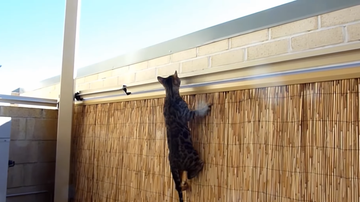
We recommend supervised sessions in the yard for the first few days after installation. Watch how your cat interacts with the boundaries so you can spot any unusual attempts to climb structures you might have overlooked.
If your cat has been free roaming before, expect them to test the limits more. Short, frequent outdoor sessions paired with positive experiences like treats, climbing posts, or interactive play help them accept their new safe territory.
Supporting Calm And Enrichment
More than half of American cat owners use calming products at some point, which shows how common it is to support indoor or contained cats emotionally. Pairing your DIY fence system with scratching posts, shaded resting spots, and puzzle feeders helps keep your cat content inside the safe zone.
Over time, most cats settle into a new routine and treat the contained yard as their normal outdoor world, which is exactly what we want for long term safety in U.S. neighborhoods.

Conclusion
DIY cat containment fundamentals are straightforward once you break them into clear steps. You assess your U.S. property for escape routes, match a cat-proof fence kit to your fence length, add targeted proofing around trees and obstacles, then introduce your cat to a yard that is finally safe.
By choosing a humane, fence-top system instead of cages or nets, you protect your cat from traffic, predators, and disease while also reducing pressure on American wildlife. With durable components, clear planning, and a thoughtful introduction for your cat, you can keep them safely contained in your own yard for years to come.


